







Denmark isn’t chasing AI hype—it’s scaling responsibly through trusted digital infrastructure, production-grade public AI, and clear governance. A deep dive into how coherence beats spectacle when regulation tightens.
Over the past year, we have observed a steady increase in interest from Danish organisations in our services. Not driven by curiosity about the latest AI models or experimental pilots, but by far more pragmatic questions: How do we scale AI responsibly? How do we stay ahead of regulation without slowing innovation? How do we preserve trust while automating more decisions?
This pragmatism is revealing. It reflects a broader Danish approach to digitalisation and AI — one that prioritises systems that function reliably over narratives that impress, even if that sometimes comes at the cost of slower decisions, complex procurement processes and capacity constraints.
A closer look at Denmark's AI and digital ecosystem suggests an important point: Denmark is not pursuing AI leadership through spectacle, but through coherence.
By coherence, we mean alignment. Alignment between policy and execution, between national and local government, between innovation and accountability, and between technological ambition and societal trust. AI is not treated as a disruptive force to be absorbed later, but as a capability that must fit into a functioning digital ecosystem from day one.
To understand how this works in practice, it is useful to look at three layers: government, business, and what this approach enables others to learn.
Government: Digital Infrastructure and Public AI at Scale
Infrastructure
Denmark's public sector forms the backbone of its digital success — a journey that began long before AI entered the policy vocabulary.
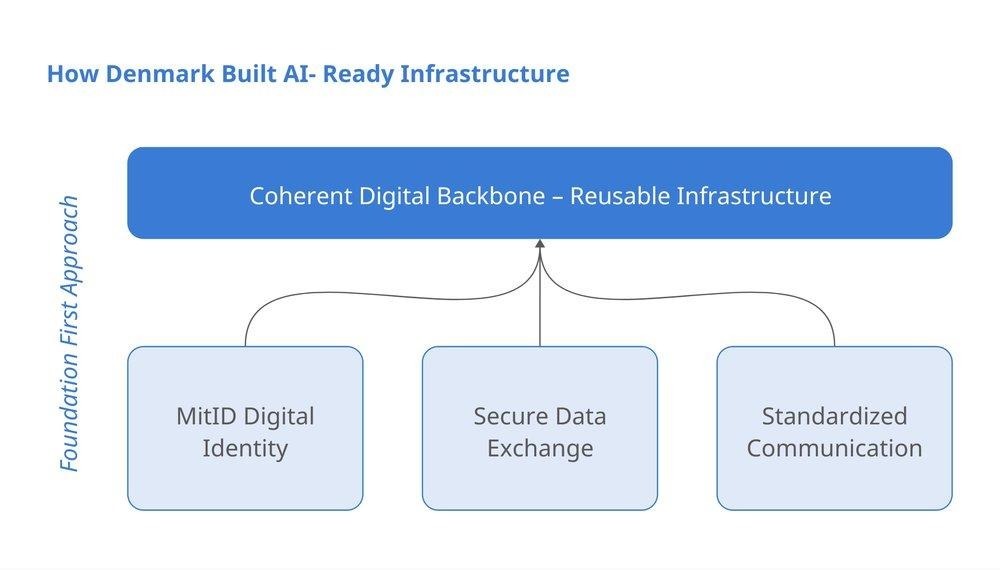
Figure 1: The architecture behind Denmark's digital advantage: Three foundational building blocks—digital identity (MitID), secure data exchange, and standardized communication—form a coherent digital backbone that public institutions reuse rather than duplicate, preventing fragmentation and enabling AI systems to scale reliably.Digital interaction with government is no longer experienced as innovation. It is routine. Citizens authenticate once and reuse that identity across healthcare, taxation, education, banking and municipal services. Official communication is digital by default. Paper-based interaction has largely disappeared.
The critical factor is not the technology itself, but the system architecture behind it. Denmark invested early in shared digital building blocks — national digital identity (MitID), secure data exchange, and standardised communication — and mandated public institutions to reuse them rather than develop parallel solutions. This prevented fragmentation across agencies and municipalities and created a coherent digital backbone for the state.
This design choice has become decisive for AI. AI does not perform well in fragmented environments. It requires reliable data flows, clear ownership of decisions, and users who already trust the surrounding system. Denmark provides exactly that. When AI is introduced, it enters an environment where responsibility, traceability and accountability are already well defined.
The outcome is visible internationally. Denmark has ranked number one in the UN E-Government Survey four times in a row, a ranking that rewards sustained adoption, inclusivity and real-world functionality rather than ambition statements or pilots.
Beyond Pilots: When Public AI Moves into Production
What distinguishes Denmark is not the number of AI pilots launched, but how many make it into everyday operations. In many countries, public-sector AI remains stuck in proof-of-concept mode — constrained by legal uncertainty, data silos or lack of institutional ownership. Denmark has deliberately focused on crossing that threshold.
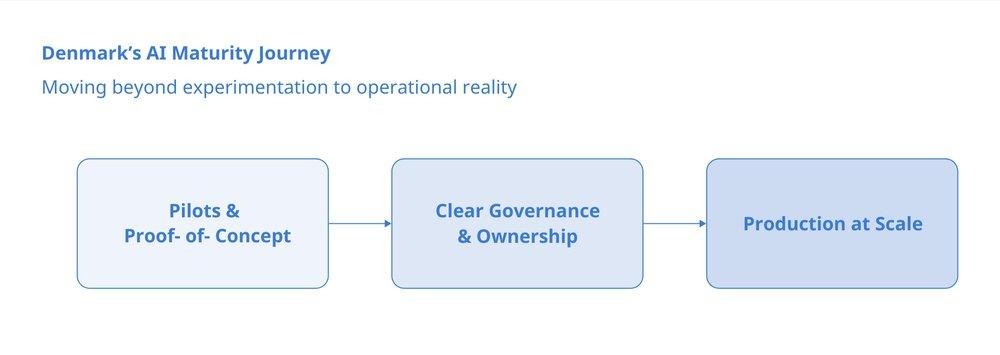
Figure 2: Beyond proof-of-concept: While most organizations remain stuck in pilot mode, Denmark deliberately focuses on crossing the threshold to everyday operations through clear ownership, defined accountability, and production-grade governance frameworks.
For business leaders, this is highly relevant. The Danish public sector effectively functions as a large-scale, regulated testbed for AI deployment under real-world constraints: privacy, accountability, explainability, workforce adoption and political scrutiny. These conditions closely resemble those faced by regulated industries such as healthcare, insurance, finance and critical infrastructure.
The most instructive Danish public AI initiatives are therefore not experimental labs, but production-grade systems that support professionals at scale, with clear governance and measurable impact.
Corti — Clinical Decision Support in High-Stakes Environments
One of Denmark's most internationally recognised AI companies is Corti, a Copenhagen-based healthtech firm specialising in real-time clinical decision support. Corti's AI analyses emergency and healthcare conversations in real time, transcribing speech and flagging medically critical indicators such as cardiac arrest or stroke. The system supports dispatchers and clinicians by highlighting risk patterns and ensuring that key questions are not missed, while keeping final decision-making firmly with human professionals.
By 2024–2025, Corti's technology was deployed across multiple European healthcare systems, including Danish emergency services, with documented outcomes such as:
- earlier detection of life-threatening conditions,
- reduced cognitive load on frontline staff,
- improved documentation quality for training and compliance.
What makes Corti particularly relevant in the Danish context is not only the model performance, but the deployment philosophy. The AI is explicitly designed as a support layer, not an automated authority. Transparency, auditability and regulatory alignment are built in from the start. This is a necessity in healthcare, but increasingly also a requirement for any high-risk AI use case.
For businesses operating in regulated or safety-critical environments, Corti demonstrates how AI can deliver tangible value without eroding accountability or trust.
Regulatory AI Sandboxes — From Uncertainty to Scalable Practice
To support responsible scaling, Denmark complements regulation with regulatory AI sandboxes that allow organisations to test AI systems under real conditions with direct guidance from authorities.
In the first national sandbox round (2024–2025), two projects were selected from 23 applicants:
- Tryg Forsikring's "Dokumentassistent", a generative AI solution supporting the summarisation and structuring of injury and insurance documentation. The system reduces administrative burden while preserving human judgement in claims decisions.
- A collaboration between Systematic A/S and the municipalities of Copenhagen, Aarhus and Aalborg, exploring AI-supported workflows in public case handling and data-intensive administrative processes.
Crucially, the outcome was not limited to internal learning. The Danish Data Protection Authority published final reports detailing legal interpretations, governance decisions and design trade-offs, providing practical guidance for organisations navigating GDPR and the phased implementation and enforcement of the EU AI Act.
For business leaders, this approach reduces regulatory ambiguity. Instead of guessing how authorities may respond after deployment, companies gain early clarity — lowering compliance risk and accelerating time to scale.
Børge — AI as Everyday Productivity Infrastructure
A more understated but revealing example is Børge, an AI writing assistant deployed across approximately 40 Danish public authorities managing content on borger.dk and lifeindenmark.borger.dk.
Børge helps editors rewrite and optimise public-facing content to meet clarity and accessibility standards. It does not publish autonomously — final responsibility remains with human editors. The value lies in productivity, consistency and skill development, not automation for its own sake.
By early 2025, Børge supported more than 1,200 content pages, demonstrating how AI can be rolled out horizontally as shared infrastructure rather than isolated tools.
Business: AI as an Operational Capability, Not a Showcase
The same logic extends into the private sector. Denmark's largest companies tend to deploy AI deep inside operations, rather than at the front of the brand. Firms such as Maersk and Novo Nordisk use AI to optimise logistics, forecasting, quality control and R&D — often in ways barely visible externally.
What is less visible, however, is the organisational work required to make this possible. In both cases, AI deployment has involved years of investment in data quality, process standardisation, internal governance and skills, long before AI models could be trusted in production environments.
At Maersk, AI supports route optimisation, port operations and supply-chain visibility — domains where reliability, explainability and traceability are business-critical. These are production systems, not demonstrations. To run them at scale, Maersk has had to align AI development closely with operational teams, establish clear ownership for model performance, and integrate AI outputs into existing decision chains rather than replacing them. This requires continuous monitoring, exception handling and fallback processes — the unglamorous but essential work of keeping AI dependable in live operations.
At Novo Nordisk, the effort is even more explicit. AI supports drug discovery, clinical trials and manufacturing quality in a highly regulated environment, where errors can have material consequences. AI systems are embedded into formal validation, documentation and audit processes, often subject to the same scrutiny as other regulated systems. This means slower iteration cycles, extensive cross-functional coordination between data science, quality, legal and clinical teams, and ongoing human oversight. AI is treated as a regulated capability that must earn trust over time, not an experimental shortcut.
What enables this is not technological sophistication alone, but organisational discipline. Expectations around data governance, accountability and compliance are relatively clear, but meeting them requires sustained effort. The payoff is that AI becomes a strategic investment decision — grounded in operational reality — rather than a reputational gamble or a short-lived innovation initiative.
AI Startups Built for Regulated Reality
Denmark's AI startup ecosystem reflects the same mindset. Rather than focusing on consumer disruption, many startups target regulated or mission-critical domains from day one:
- FarmDroid — autonomous, solar-powered weeding robots using AI and robotics for precision agriculture.
- Abzu — explainable AI for pharmaceutical research and complex modelling.
- Hedia — personalised AI-driven diabetes management solutions.
These companies often secure early customers in healthcare, utilities, manufacturing and public services, encountering regulatory and governance constraints early — and building with them in mind.
As a result, Denmark has fewer headline-grabbing AI unicorns, but also fewer public failures and trust breakdowns. The ecosystem rewards deployability and robustness over rapid valuation growth.
What Denmark's AI Governance Model Can Teach: Scaling AI Without Losing Trust
Denmark's experience highlights a frequently overlooked lesson about AI readiness: it is rarely about AI alone.
Countries and organisations that invested early in digital identity, interoperability, data governance and accountability now face far less friction when adopting AI. These foundations reduce uncertainty for citizens, civil servants, executives and regulators alike. They do not remove complexity — but they make complexity manageable.
Denmark also shows that AI governance does not automatically slow innovation. In many cases, it accelerates it. Clear rules, clear ownership and mechanisms such as regulatory sandboxes reduce fear of unintended consequences, making leaders more willing to move beyond pilots and into production. That said, governance does not solve everything. Procurement processes can still delay implementation, skills remain unevenly distributed, and consensus-driven decision-making can slow momentum.
Perhaps most importantly, Denmark treats trust as cumulative. It is built slowly, maintained carefully and rarely advertised. AI is expected to fit into that trust framework, not redefine it. This creates constraints — but also resilience when systems scale and scrutiny increases.
In a global race to deploy AI quickly, Denmark's AI governance model offers a quieter but more durable counterpoint. The most advanced AI societies — and organisations — may not be the fastest, the loudest or the most visible, but the ones that continue to function when mistakes become costly.
For leaders, the implications are concrete:
If AI is stuck in pilots, stop buying new tools and fix ownership
Assign a clear business owner to each AI system, clarify who is accountable for outcomes, and ensure data quality and access are solved before expanding use cases.
If teams hesitate to deploy AI, reduce uncertainty rather than pushing speed
Define what is permitted, what is not, and who decides when something goes wrong. Clear guardrails move projects into production faster than ambitious roadmaps.
If trust is a concern, deploy AI where it supports people first
Start with AI decision support, prioritisation and documentation in high-stakes areas, and only automate decisions once accountability and oversight are proven.
If speed matters, invest in repeatability instead of one-off wins
Shared data foundations, reusable components and trained teams will outpace isolated "breakthrough" use cases within a year.
For governments and businesses alike, the Danish AI governance model suggests that the real competitive advantage in AI is not moving first, but being able to keep moving once systems scale, regulation tightens and mistakes become expensive.
Download the expert insight here.