





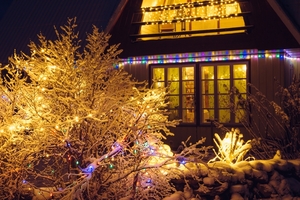


During the Christmas and New Year season, a distinct sight around the globe today compared to previous times, is the decorative lights in all different shapes and forms, outside and inside houses and buildings, in streets and squares, etc. It is especially visible and appreciated in the northern hemisphere, in countries with many dark hours at this time of the year.
What has caused this situation is clearly the invention and amazing development of the light source LED (Light-Emitting Diode), partly because of the possibility of having miniature light bulbs but mainly because of low energy consumption.
With the increased focus on energy efficiency and sustainability, LED has become one of the most transformative lighting technologies of our time. Originally developed about 100 years ago, LED bulbs began as simple indicators before becoming powerful, efficient light sources that now illuminate everywhere.
It started with the discovery of electroluminescence in the early 1900s, but practical devices did not appear until the 1960s when early red LEDs were introduced. Progress then accelerated and led to the invention of high-brightness blue LEDs in the 1990s; a breakthrough that enabled the creation of white LED light and later earned researchers the Nobel Prize in Physics.
LED lights often consume up to 85 % less power than traditional incandescent bulbs, which has made them a staple in residential and commercial lighting. So let alone the use for decorations, LED is today widely used for street lighting, automotive headlights, electronic displays, and even in greenhouses for plants where tailored light spectrums increase plant growth. Their long lifespans and falling prices have helped drive global adoption, reducing both energy costs and carbon emissions.
The future outlook for LED technology also remains bright. Innovations in materials and design are pushing efficiencies even higher, while smart lighting systems integrate LEDs with sensors and connectivity for adaptive, automated illumination. Researchers are also exploring next-generation applications in medical therapy and advanced communication systems such as visible light communication (VLC). As sustainability becomes ever more central to global infrastructure, LED lights are set to play a key role in the transition to a greener future.
More information may be found e.g. here
(This article is based on the information posted on internet; edited by T.Sollie)