






.jpg?width=300&name=shutterstock_2064717023%20(1).jpg)

After years of setbacks and muted expectations, the sector of autonomous, self-driving vehicles (SDV) is said to be now shifting from hype to deployment, as industry leaders increasingly see it as a core component of the fu-ture transportation network.
The development ranges from full autonomy to various hybrid solutions which are closer to consumer adoption.
Many people wonder what are the pros and cons of fully self-driven vehicles? The enthusiasts claim benefits, including:
-
Improved road safety (as human error causes most accidents caused by distraction, fatigue, or intoxication)
-
Increased mobility (for people who cannot drive, expanding access to jobs, healthcare, and social activities)
-
Reduced traffic congestion (as SDVs can communicate and optimize driving patterns to smoothing traffic flow)
-
Environmental benefits (as electrical drive + efficient routing help to reduce emissions and urban air pollution)
The sceptics on their side claim risks and downsides, including:
-
Safety and reliability concerns (due to complex urban environments, weather and unexpected human behavior)
-
Mixed traffic complications (when sharing roads with human-driven cars, unpredictable interactions can occur)
-
Cybersecurity risks (being vulnerable to hacking, data breaches, or malicious interference)
-
Job displacement (as millions of driving-related jobs can be disrupted, raising economic and social challenges).
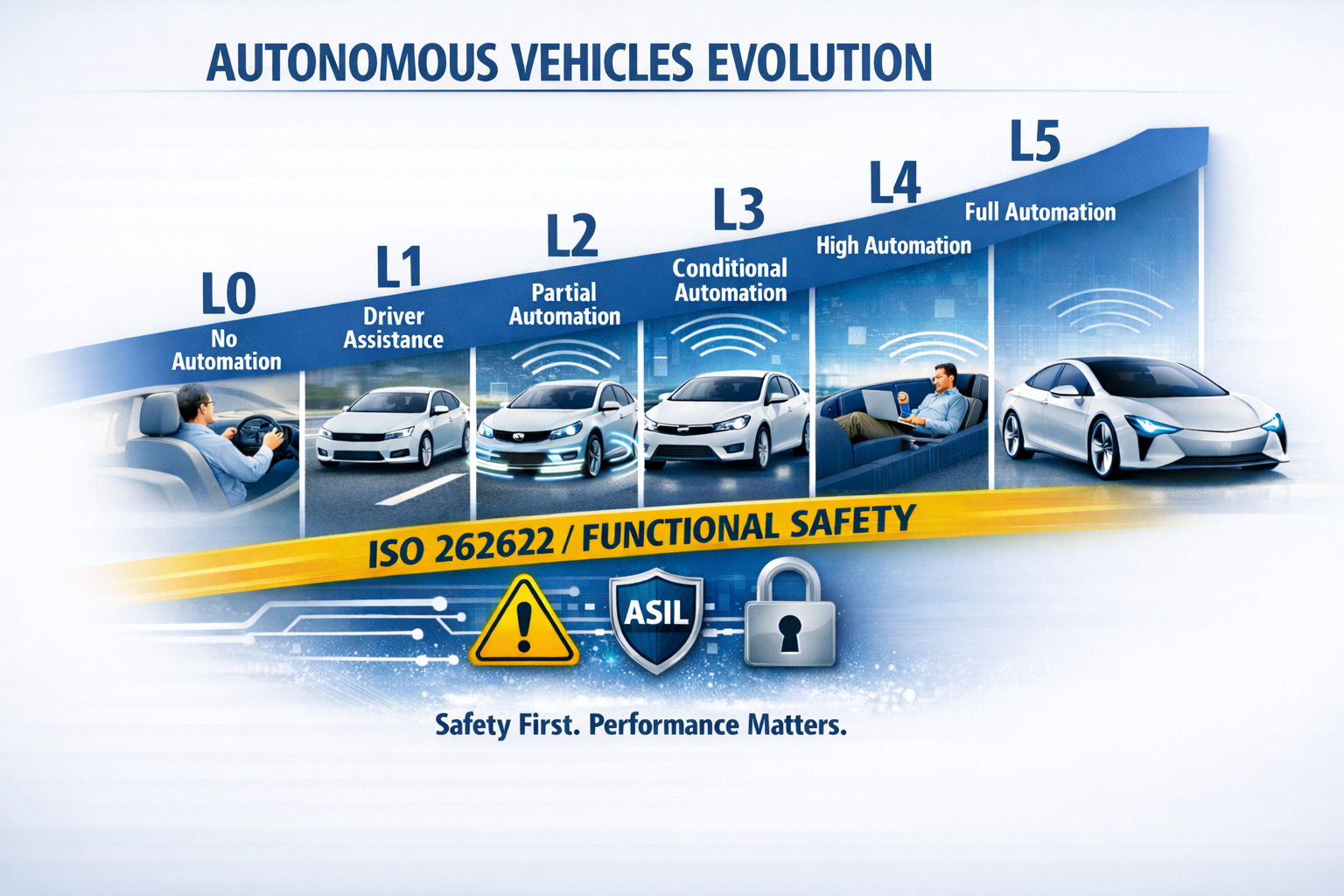
Regulations being both catalyst and constraint, emerge globally from e.g. United Nation and nationally e.g. in USA, China and Europe, and aim to ensure that autonomous systems meet or exceed human driving safety levels.
For SDVs, functional safety is clearly most critical. An international standard for this is ISO 26262, which offers a systematic approach for manufacturers to determine hazards, evaluate risks, and put measures in place to ensure safety when developing electrical, electronic, and programmable automotive devices.
From airbags to steering, advanced driver assistance systems and now artificial intelligence-based decision-
making, safety-relevant functions must work properly, even in case of defects.
In contrast to conventional cars, SDVs rely on continuous integration of hardware and software with regular
over-the-air updates. Manufacturers must reconsider their compliance approaches and lifecycle safety management accordingly.
Whether/when SDVs will become a mainstream mobility solution or stay limited to niche applications, remains to be seen. Hybrid models, combining human drivers with autonomous fleet, are likely to dominate in the near term.
With its expertise in functional safety and cybersecurity as well as product compliance, Nemko is well placed to
support the automotive industry into the age of software-defined vehicles.
For further information and/or support, please contact Igor.Duspara@nemko.com
(This article is triggered by a blog article by Luis Gonzalez (Nemko USA); edited by T.Sollie)